The Summer Palace in Beijing is a renowned UNESCO World Heritage Site and one of the most popular historical landmarks in China. Originally constructed in 1750 during the Qing Dynasty, it served as an imperial garden and summer retreat for the emperors.
The Summer Palace is located about 15 kilometers northwest of central Beijing and covers an expansive area of around 290 hectares, dominated by Longevity Hill and Kunming Lake.
Explore more Beijing tourist attractions:
- Hutongs in Beijing: where to find the best location
- Tiananmen square – the most important place in PRC
- How to get to the Great Wall of China?
History of the Summer palace

The Summer Palace was originally built by Emperor Qianlong but was severely damaged during the Second Opium War (1860) and later during the Boxer Rebellion. It was rebuilt and expanded by Empress Dowager Cixi in the late 19th century, who used it as her primary residence.
The palace represents the pinnacle of Chinese garden design, blending natural landscapes with man-made structures. Its design reflects the harmony between humans and nature, making it a quintessential example of traditional Chinese architecture and horticulture.
What to see in Summer palace in Beijing
Kunming Lake

This large, man-made lake takes up about three-quarters of the Summer Palace area.
t’s surrounded by beautiful landscapes and dotted with bridges, pavilions, and ancient architecture. You can take boat rides or walk along the scenic shores.
Longevity Hill

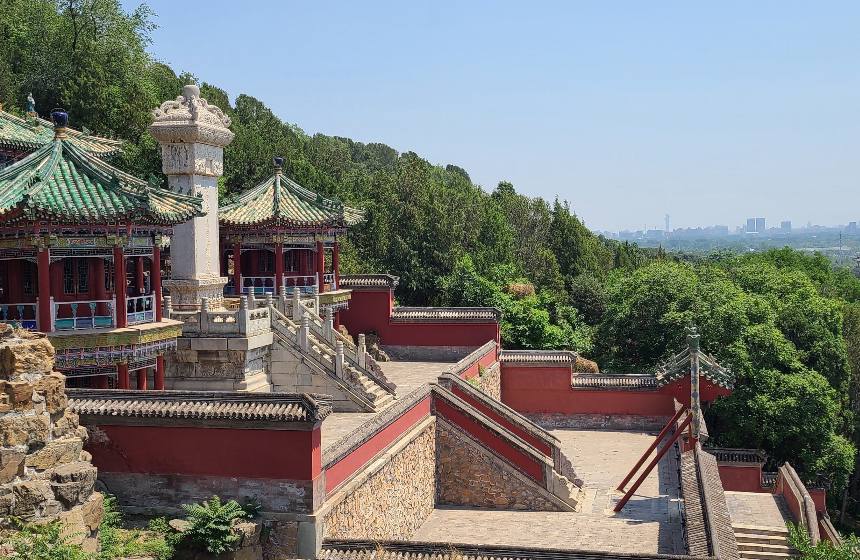
Rising above Kunming Lake, this hill is adorned with temples, pagodas, and halls. The Tower of Buddhist Incense (Foxiang Pavilion) sits at the top of Longevity Hill and offers panoramic views of the entire palace grounds and the surrounding area.
Long Corridor
This covered walkway stretches for over 700 meters and is decorated with thousands of colorful paintings depicting Chinese legends, historical events, and scenic landscapes.
Marble Boat

Also known as the “Boat of Purity and Ease”, this stone structure is located on the shore of Kunming Lake and was commissioned by Empress Dowager Cixi.
Though it is not a functioning boat, it serves as an architectural symbol.
Seventeen-Arch Bridge

A striking bridge with seventeen arches that connects the eastern shore of Kunming Lake to Nanhu Island. It’s famous for its elegant design and is a popular spot for photography.
Hall of Benevolence and Longevity
This hall served as the administrative center of the Summer Palace, where the emperors would conduct state affairs.

How to visit Summer palace in Beijing
Visiting the New Summer Palace (Yiheyuan) in Beijing is a wonderful experience, and it’s one of the city’s most famous cultural landmarks.
Please, be aware that there is another Summer Palace in Beijing called Old Summer Palace. These two are different places, but located not far from each other.
Your visit to the New Summer Palace can take from half a day to a full day, depending on how much you want to explore. It’s a must-see destination in Beijing for its combination of natural beauty and historical significance.
Main Entrances

- East Palace Gate (Donggongmen):
This is the main entrance and the most popular for visitors. It’s close to many of the major attractions, including Kunming Lake, Longevity Hill, and the Long Corridor.
- North Palace Gate (Beigongmen):
This entrance is less crowded and offers easy access to Longevity Hill and the Tower of Buddhist Incense.
- New Palace Gate (Xingongmen):
Located in the south, this gate is convenient if you’re visiting the southern parts of the palace grounds.
How to get to the Summer palace
- Location
The Summer Palace is located about 15 kilometers (9 miles) northwest of Beijing’s city center, in the Haidian District.
- By Subway:
Take Line 4 of the Beijing Subway to Beigongmen Station (北宫门), Exit D. From here, it’s about a 5-10 minute walk to the northern gate of the Summer Palace.
Alternatively, you can take Line 10 to Xiyuan Station (西苑) and then transfer to Line 4 or walk about 20 minutes to the East Palace Gate.
- By Bus:
Several buses can take you to the Summer Palace. Common routes include buses 303, 331, 332, 346, 374, and 563. Most buses stop near the East Palace Gate or North Palace Gate.
- By Taxi:
Taking a taxi from central Beijing to the Summer Palace is convenient. It usually takes 30-40 minutes depending on traffic and costs around 50-70 CNY ($7-10 USD).
- By Bike:
Beijing has bike-sharing services, and biking to the Summer Palace is a scenic option. There are dedicated bike lanes, and the ride from central Beijing is about 1 hour.

Opening Hours
- April to October (Peak Season):
6:30 AM to 6:00 PM (last entry)
Grounds close at 8:00 PM
- November to March (Off Season):
7:00 AM to 5:00 PM (last entry)
Grounds close at 7:00 PM
- Note: Some specific attractions within the Summer Palace (like Suzhou Street or the Tower of Buddhist Incense) may have different hours.

Ticket Prices
- General Admission:
April to October (Peak Season): 30 CNY (~$4.50 USD)
November to March (Off Season): 20 CNY (~$3 USD)
- Combo Ticket (includes admission to specific areas like the Tower of Buddhist Incense, Dehe Garden, Suzhou Street, and Wenchang Hall):
April to October: 60 CNY (~$9 USD)
November to March: 50 CNY (~$7.50 USD)
- Tip: If you’re interested in seeing the detailed areas (like the Tower of Buddhist Incense), it’s worth getting the combo ticket.
What to visit nearby
- Peking University and Tsinghua University:
These prestigious universities are nearby and worth visiting for their historical significance and beautiful campuses.
- Old Summer Palace (Yuanmingyuan):
Just a few kilometers away from the Summer Palace, you can also visit the ruins of the Old Summer Palace for a deeper understanding of Chinese imperial history.
More ideas for the perfect trip: